

A Researcher Who Leads Engineering Studies - From Rockets to Cancer Research
Dr. Oshrit Hoffer, head of the School of Electrical Engineering at Afeka Academic College, talks on the People and Computers podcast about how she combines academic teaching with breakthrough studies in defense, aerospace, and medicine
By Yehuda Konfortes
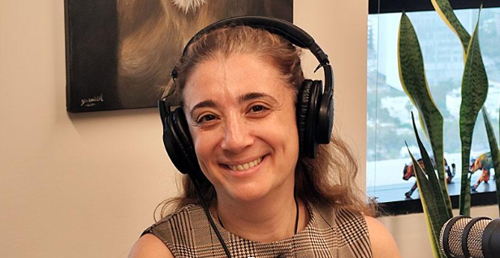
Dr. Oshrit Hoffer, head of the School of Electrical Engineering at Afeka Academic College. Photo: Nir Matarasso, People and Computers
Dr. Oshrit Hoffer is one of Israel’s most prominent researchers. Among other things, she studies energy, defense, aviation, medicine in general, and cancer in particular. Dr. Hoffer is head of the School of Electrical Engineering at Afeka Academic College, having served in the role for a year and a half.
In an interview for the People and Computers podcast, she describes a study she conducted together with Dr. Yinon Yavor, also of Afeka College, which uses computer vision and AI to analyze the combustion process of rocket fuel, and thus to achieve better fuel efficiency. She also describes other studies she has led, detailing how engineers are trained in the age of AI, and how Afeka college copes with states of emergency, when half the student body is called up for reserve duty.
Tell us a little about yourself. How did you end up in the sciences?
“I serve as head of the School of Electrical Engineering at Afeka Academic College, and additionally do research. I’ve always had an interest in science. In the army, I served in the Flight Academy, tutoring flight cadets. I taught them math, physics, aerodynamics, and more. I was exposed to the vast beauty of engineering, so right after being discharged I turned to academic studies. I completed my bachelor’s and master’s degrees at Ben-Gurion University, and my doctorate at Tel Aviv University. My doctoral thesis was in computer vision.”
Please explain your research on planning fuel consumption in a rocket engine.
“This study is in collaboration with Dr. Yinon Yavor, head of the School of Mechanical Engineering at Afeka, and this field is his baby. The rationale is that when rocket fuel is burned, it contains tiny aluminum particles, and there’s a combustion process that causes the particles to meld and collide. Some of them clump and create small clusters called agglomerates. These agglomerates affect the fuel’s burn rate, how much energy is actually released, and how they flow within the engine.”
What solution did you find?
“By analyzing videos of fuel combustion we can identify and quantify those clumps, because their size and amount directly affect fuel efficiency and engine performance. That is, it’s a function of efficiency, which can both save energy and improve the performance of the various types of rockets.
“The researchers on this study included students of ours, as part of their graduation project, and others from the college faculty. The trials we ran with the help of the students showed amazing results, and we submitted for publication in a major academic journal.”
What other studies did you collaborate on?
“Another study at our research group is about developing a method to detect defects in 3D-printed aviation components, using acoustic signal analysis and AI. The system taps on the component and analyses the resulting soundwaves to identify defects. We conducted this study together with IAI (Israel Aerospace Industries) and got funding for it. The study was published in a very important international journal in this field.”
Tell us more about your doctoral research.
“My thesis was about the use of thermal cameras and AI to detect and monitor the treatment of cancer. Cancerous tumors generate heat due to the high rate of cell proliferation and the network of blood vessels around them, so you can detect ‘hotspots’ with thermal imaging. This study led to four patents and numerous publications.”
What role does the link between academia and industry play with you?
“We live and breathe applied research, and highly encourage it. In fact, all of our studies are applied. For example, our collaboration with IAI came as a result of a problem they presented to us. We have many other examples of collaborations with the industry. We also receive funding from the Israel Innovation Authority for applied studies.”
“AI won’t replace the engineer”
How are engineers trained for the age of AI?
“The School of Electrical Engineering is among the college’s largest, with 160 to 180 undergraduate students. There’s no doubt that AI is an iconic thing that must be addressed and familiarized with, but you need to remember that it won’t replace the basic knowledge needed in math, physics, basic engineering. AI helps with information, and that’s very important. It’s geared towards critical thinking, so we can distinguish between what’s logical and what isn’t, but it won’t replace the engineer.
“We certainly encourage students to use AI tools, but we also teach them to appreciate the limitations. At the end of the day, in order to develop you need skills that today’s AI doesn’t have yet. Not just knowledge, but skills such as teamwork, public presentation and other important things, which we invest in quite a bit, in all engineering disciplines.”
What’s the profile of the engineer that you train?
“Electrical engineers are hardware engineers who build physical things, such as computer chips, but can also code. That is, an electrical engineer who graduates from Afeka has knowledge and abilities that combine skills from both hardware and software. Since this field is very broad, anyone can find themselves within it, in a variety of industries, which is why our alumni have one of the highest placement rates in the industry.”
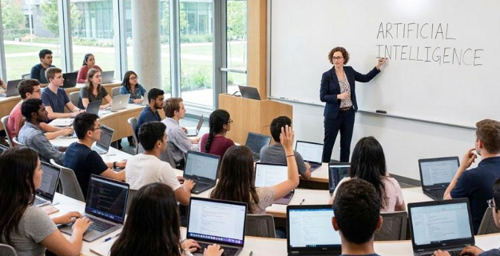
Artificial intelligence – in the lecture hall as well. Photo: Gemini
What’s the difference between your student and a university alumnus?
“I’m glad you asked. I recently spoke with an Afeka alumnus, and he told me that when he entered his new workplace, he already had practical experience, because it’s part of the program here. The students complete project, get to touch systems. He received a project and finished it up in two weeks. In contrast, academic alumni had a much harder time, and that’s the advantage for those who choose to study here.”
How do you cope during wartime?
“It’s tough. Almost half our students were called up for reserve duty. We did all we could to give them the support system, to help them. A student who comes back from serving isn’t the same student he was before, including emotionally and mentally, and we gave them lots of support and follow-up courses. To me, they’re the real heroes – both by protecting us as soldiers and by not giving up scholastically. They don’t ask for more than the basic considerations, and they score high grades.”
From Rockets to Cancer Research
Share a link using:
https://www.afeka.ac.il/en/afeka-news/magazine/from-rockets-to-cancer-research/WhatsApp
Facebook
Twitter
Email
https://www.afeka.ac.il/en/afeka-news/magazine/from-rockets-to-cancer-research/