


Everyday Experiences That Shape My Research
My research is often inspired by challenges I encounter in everyday life. When I began my doctoral studies at Tel Aviv University, I was intrigued by the city’s apparent suitability for cycling and yet the limited presence of dedicated bike lanes. Coming from Paris, where I had witnessed the early success of the bike-sharing system, I found this contrast intriguing. I discussed the issue with my supervisors, and after some deliberation, we decided to explore this topic as my Ph.D. research, developing optimization models to improve the balance and service levels of bike-sharing systems. It was a pioneering and somewhat risky research project, as we were among the first to apply optimization techniques to this emerging field. What made this journey even more rewarding was that, during the course of my doctoral studies, a bike-sharing system was launched in Tel Aviv, allowing me to see the city begin to adopt the very ideas that had inspired my research.
Our research proved to be very successful: the models we developed were widely cited and contributed to a growing body of work on urban bike-sharing systems. What motivated me most was the opportunity to make a tangible contribution to environmental sustainability. By enhancing the efficiency of large-scale bike-sharing systems, I hoped to encourage more people worldwide to reduce car usage, promote physical activity, and ultimately support more livable and resilient urban environments.
Building on this experience, I have continued to focus on research that bridges human behavior, urban systems, and environmental well-being. My current project also emerged from a personal experience. I have never enjoyed driving and have always preferred using public transportation. However, during the summer months, I found that even a short walk between my home and the nearest bus stop could be exhausting because of the intense heat and the lack of shade. I began to wonder how it was possible that in such a hot country, urban environments were not systematically planned to provide shaded walking paths for residents.
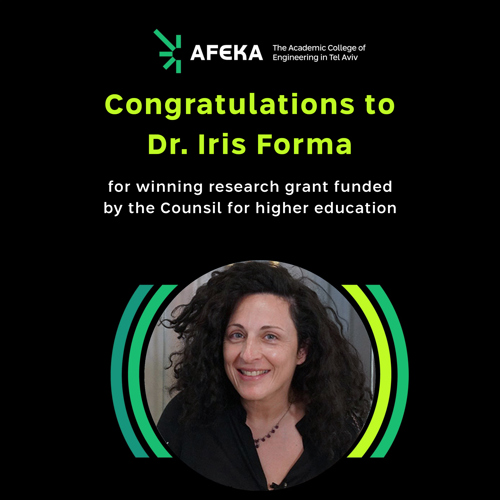
This question inspired me to explore how mathematical modeling and optimization techniques could be used to support urban planning decisions aimed at improving outdoor thermal comfort. This idea has since evolved into my current research project, for which I recently received a feasibility grant from the Israeli Council for Higher Education and the Planning and Budgeting Committee. The project combines my long-standing interest in sustainability with my expertise in modeling and decision-support systems, and it continues to fuel my passion for creating more livable and climate-resilient cities.
How I Got Here
I hold a Bachelor's degree in Mechanical Engineering from the Technion, Israel Institute of Technology, a Master of Science in Industrial Engineering from Polytechnique Montréal in Canada, and a Ph.D. in Industrial Engineering from Tel Aviv University. My academic background combines engineering design, systems analysis, and data-driven methodologies, providing a comprehensive foundation for addressing complex problems in industrial and urban systems.
The Collaborations That Move My Work Forward
For a long time, I enjoyed working independently and found great satisfaction in developing ideas on my own. However, in recent years, I have come to appreciate the richness and creativity that emerge from teamwork. Collaboration has opened new perspectives and significantly improved the quality and scope of my research.
In past research, I collaborated with Prof. Gonen Singer and Dr. Hila Halutz Ben-Gal from Bar-Ilan University on the development of bi-level optimization models in the field of workplace well-being. This collaboration enabled a truly interdisciplinary approach and resulted in the publication of two papers. Once again, our work was pioneering, as we were among the first to model workplace well-being using optimization methods.
In my current project, I am working with Dr. Ohad Eisenhandler, my colleague at Afeka College of Engineering. This collaboration has considerably enhanced the project’s quality and depth. As our work evolved, we realized the need for climate-related data, which was beyond our own areas of expertise. We therefore invited Dr. Or Aleksandrowicz, head of the Big Data in Architectural Research Lab at the Technion, to join the project. This partnership has given the research a more applied and interdisciplinary dimension.
Today, we are also collaborating with the Center for Urban Forestry and Shading of the Israel Green Building Council, and we are conducting pilot studies in three Israeli cities: Hod Hasharon, Ra’anana, and Eilat. These partnerships strengthen the practical impact of our work and demonstrate the value of interdisciplinary collaboration in addressing real-world urban and environmental challenges.
The Mentors Who Shaped My Path
Very early in my studies, during my final undergraduate projects, I chose to work on research-oriented topics. Later, during my master’s degree, I met two professors in Canada, Prof. Gilles Savard and Prof. André Langevin, who had a strong influence on my career. They were the first to encourage my creativity and to help me discover my passion for research. They also believed in my abilities, which gave me confidence and motivated me to continue toward a Ph.D. Their working methods still influence the way I approach problem modeling today. They are not only excellent researchers but also people with strong human values and great communication skills, which I believe are equally important.
During my doctoral studies, my supervisors, Prof. Micha Tzur and Prof. Tal Raviv, further shaped my professional development. They taught me new ways of thinking and working that I continue to apply in my research today.
For me, good mentorship and leadership in engineering science combine intellectual rigor with empathy, open communication, and the ability to inspire others to think creatively and independently.
Advice for Young Engineers and Scientists
My main advice to young engineers and scientists is not to be afraid of taking risks. Go after the topics that truly excite you. It is impossible to do good research on something that doesn’t inspire you or that you don’t believe in deeply. Passion gives you the energy to work hard and to be creative.
Doing research only to publish papers or move up the academic ladder doesn’t make much sense to me. What really matters is the meaning and content of your work, having that spark and curiosity that push you forward.
It is also very important to build strong skills, to learn the tools that help you understand problems and use knowledge in a deep way. And finally, always stay open to feedback and criticism. Being open-minded and willing to learn from others is the best way to grow as a researcher and as a person.
The Future of Engineering Science
I believe that the greatest impact of engineering science in the coming years will be related to climate change, both in addressing its causes and in adapting to its consequences. Engineers will play a key role in developing technologies and decision-support tools that help societies reduce emissions, improve energy efficiency, and design more sustainable cities and infrastructures.
At the same time, engineering science will increasingly combine traditional technical fields with data science, artificial intelligence, and environmental modeling. This integration will allow us to create smarter, more resilient systems that respond dynamically to environmental and social challenges.
Given that more than two-thirds of the world’s population is expected to live in cities by the end of the century, I believe that urban areas will experience the most significant transformations. Engineering science will be central to redesigning how cities function, from mobility and energy to microclimate and infrastructure, with the goal of improving both environmental performance and quality of life for residents. Achieving this will be a major challenge, requiring not only technological innovation but also long-term vision, interdisciplinary collaboration, and the ability to balance environmental, social, and economic priorities.
Staying Connected to the Research Community
I make it a point to stay actively involved in the international research community. Each year, I attend at least one major international conference, such as the INFORMS Annual Meeting, to stay up to date with the latest scientific developments and to engage with colleagues working on related challenges around the world.
I also contribute to the academic community as a reviewer for leading journals, including Transportation Research and Omega. Reviewing allows me to stay connected to new research trends and support the continued advancement and integrity of our field.
Looking Ahead
My work is driven by the belief that engineering science can and should contribute to creating cities and systems that are both efficient and humane. Through modeling, data analysis, and interdisciplinary collaboration, I aim to translate scientific insight into practical solutions that improve everyday life while supporting a sustainable future.
Dr. Iris Forma
Senior Lecturer, School of Industrial Engineering and Management
Afeka - The Tel Aviv Academic College of Engineering
Email: irisf@afeka.ac.il
Dr. Iris Forma
Share a link using:
https://www.afeka.ac.il/en/december-2025/dr-iris-forma/WhatsApp
Facebook
Twitter
Email
https://www.afeka.ac.il/en/december-2025/dr-iris-forma/